
Full Spectrum vs Red and Blue Grow Lights
White full spectrum grow lights and purple red and blue lights both feed plants. Here is how they differ, where each fits, and which suits a home.
 By Ethan Cole
Updated November 2, 2026
Grow lights come in two looks: white (sold as full spectrum) and purple-pink (red and blue). Both are made to drive photosynthesis. The difference is how the light is spread across colors, how it looks in your home, and how well you can see your plants under it.
Quick Answer
For plants in rooms you use, choose a white full spectrum light, ideally with some added deep red (often listed as 660nm). Red and blue lights make sense in a basement, garage, or closet where looks do not matter.
Side by Side
| Full spectrum (white) | Red and blue (purple) | |
|---|---|---|
| How it looks | White, like a household light | Purple or pink |
| Color of plants under it | Close to true | Distorted; hard to spot problems |
| Spectrum | Broad, with blue, green, red; often added 660nm | Concentrated in red and blue bands |
| Best place | Living rooms, offices, kitchens | Basements, garages, grow closets |
| Example | VIPARSPECTRA P700 (3000K + 5000K + 660nm) | Hytekgro 225 LED (163 red, 58 blue, 4 white) |
Why Red and Blue Lights Exist
Chlorophyll absorbs blue and red light most strongly, so early LED grow lights used only red and blue diodes to put their power there. Plants still use other colors, including green, which reaches deeper into the leaf canopy.
Why White Lights Took Over for Homes
White LEDs (often 3000K to 5000K) cover the whole visible range, and many makers add 660nm red. The light looks normal, plants look their real color, and you can spot yellowing, pests, or bleaching. That is why most lights in our full spectrum LED grow light guide are white.
The Two Example Lights

70 Watt Grow Light, Dimmable Plant Light


As an Amazon Associate we earn from qualifying purchases. Product prices and availability are accurate as of the date/time indicated.
The VIPARSPECTRA P700 mixes 3000K and 5000K white with 660nm red in a 70W panel, rated 4.7 stars on about 5,300 ratings. It looks white with a warm tint.
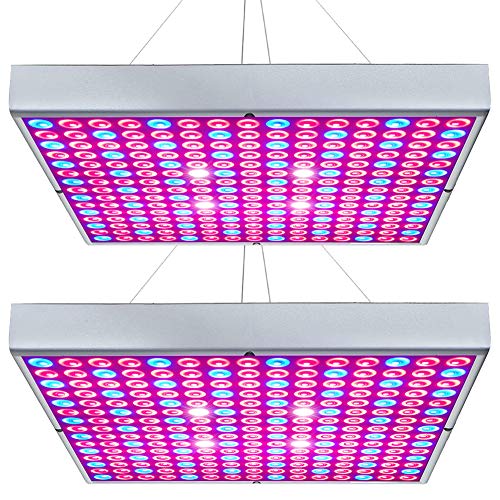
Hytekgro LED Grow Light 225 LEDs Plant Lights Red


As an Amazon Associate we earn from qualifying purchases. Product prices and availability are accurate as of the date/time indicated.
The Hytekgro panels use 163 red, 58 blue, and only 4 white LEDs each (45W listed), rated 4.4 stars on about 3,600 ratings. They glow purple-pink.
What About Color Temperature?
Among white lights, 3000K looks warm and blends with home lighting; 4000K to 5000K looks like daylight. Both are used for plants. Some lights, like the chiphy tall lamp, let you tune from 2300K to 6500K.
Eye Comfort
Purple light makes it hard to judge colors and can be unpleasant to work under. Whatever the color, avoid looking straight into bright grow LEDs at close range, and take extra care with lights that list UV or IR diodes.
Which Should You Buy?
- Plants in a living space: white full spectrum.
- Seed starting in a basement on a budget: red and blue is fine.
- Fruiting plants: white with added red, such as the P700 or GE Flowers & Fruit.
Ratings checked November 1, 2026. Specifications are from each seller’s Amazon listing; we did not measure spectra. Method: How We Review.
Who Should Look Elsewhere
If your plants already sit in a bright window most of the day, you may not need either type. If you grow in a tent, fixtures sized and charted for tents are a better fit than these home lights.
Frequently Asked Questions
Are purple grow lights better than white?
Not for most homes. Both feed plants; white lets you see your plants and fits living spaces.
Is a ‘full spectrum’ label regulated?
No. Makers use it loosely. A published spectrum chart or PPF figure tells you more than the label.
Do white grow lights need extra red?
Many add 660nm red; it is common in lights aimed at flowering and fruiting plants.
About the author
Ethan Cole leads research and editing at WikiHomeLED, comparing LED lighting for the home through manufacturer specs, manuals, safety listings and owner feedback. Every product is scored against the criteria on our How We Review page, and picks are updated when models change.