
TV Bias Lighting: What It Is and What Color Temperature to Use
Bias lighting is a soft, neutral light behind the TV. We explain why 6500K is the usual choice, how bright to set it, and how to tell which kits have a real white mode.
 By Ethan Cole
Updated October 30, 2026
Bias lighting is a light placed behind a TV so it lights the wall around the screen. Unlike a color-changing backlight, the idea is to stay in the background: a steady, neutral white glow, so the screen is not the only light source in a dark room. It is the simplest and least expensive kind of TV backlight, and it is often what people mean when they search for one.
A note on health claims: many listings make health claims about bias lighting. We do not repeat them, because they are medical claims we cannot verify. If you have eye discomfort, ask an eye care professional.
Why 6500K Is the Usual Choice
Color temperature describes how warm or cool white light looks, measured in kelvin (K). Candlelight is around 1,900K, household warm white bulbs are usually 2,700K to 3,000K, and 6,500K is a cool, neutral daylight white.
6500K matters for TV because it is the reference white the video industry uses. The standard white point for HD and Ultra HD video, called D65 in the ITU-R BT.709 and BT.2020 recommendations, corresponds to about 6500K. A TV in its movie or filmmaker mode aims for that white, so a bias light at the same color temperature sits neutrally behind the picture instead of tinting how you perceive it.
Warm white behind the screen is a valid taste choice, particularly for casual viewing, but it is not neutral. Very blue or saturated colors behind the TV pull the most attention away from the picture.
How Bright It Should Be
Bias lighting should be dim: a soft wash on the wall rather than a bright frame. A good starting point is to set it low enough that you notice it only when you look for it, then adjust to taste.
White vs RGB Kits
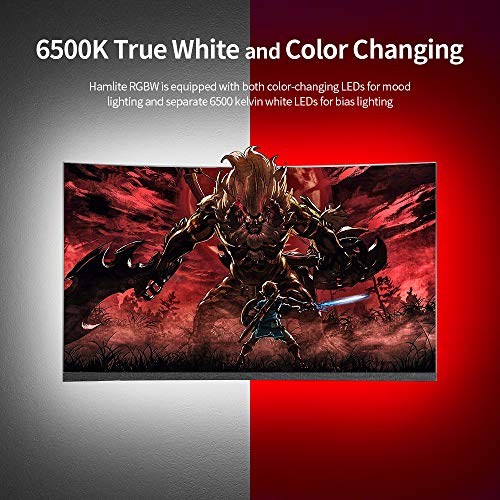
Many cheap USB strips are RGB only. They make “white” by mixing red, green, and blue, which usually looks bluish or pinkish and rarely matches 6500K. For a true white, look for one of these on the listing:
- A stated color temperature, such as “6500K True White”. HAMLITE and Power Practical sell USB kits listed this way.
- A separate white LED in each bead: RGBW, RGBIC with a white channel, RGBICW, or RGBWW. The Govee TV Backlight 3 Lite (RGBICW) and TV Backlight 3 (RGBWIC) are examples.
- Tunable white with a range, such as 3000K to 6500K. Tatazone lists RGBWW TV strips with this range. Philips Hue’s White and Color Ambiance strips cover warm to cool white.
Some kits list a white color without a temperature, such as CPLID’s 5000K white. It works as a neutral glow but is cooler or warmer than the video standard depending on the number.

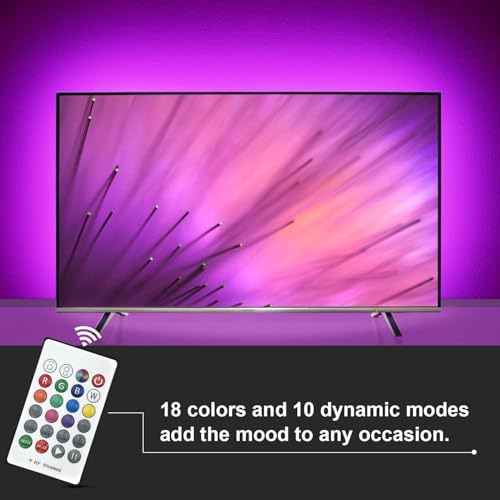
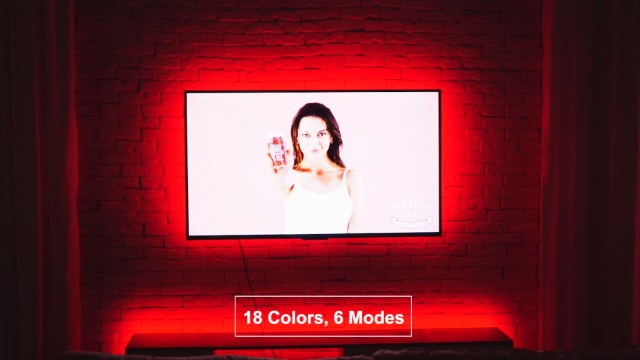
Prime HAMLITE TV Bias Lighting 6500K True White (18ft)




As an Amazon Associate we earn from qualifying purchases. Product prices and availability are accurate as of the date/time indicated.
Setting It Up
Mount the strip around the back of the TV a few inches in from the edge so the light spreads onto the wall. If the TV sits close to a wall, the effect is stronger; if it sits far from the wall, there is less to light. A light, neutral wall color shows bias lighting best; a strongly colored wall tints the light.
For step-by-step mounting, see how to install a TV backlight.
Bias Lighting on OLED TVs
OLED TVs are very thin and often have a raised panel only in the lower part of the back. The same strips work, but you may need to run the strip along the thicker section or use clips. A bias light does not change the TV’s picture; it only lights the wall behind it.
Do You Need Screen Sync?
No. Screen-sync kits that follow the picture are a different product with a different purpose. Many of them also have a static white mode, so one kit can do both. If you want both options, see camera vs HDMI sync and our main guide to the best TV backlights.
Who Should Look Elsewhere
If you mostly watch in a bright room during the day, bias lighting makes little visible difference. And if your TV is on a stand far from any wall, there is nothing for the light to fall on.
How We Researched This
The color temperature standard comes from ITU-R Recommendations BT.709 and BT.2020, which specify the D65 white point. Product examples come from manufacturer listings on Amazon, checked October 2026. We did not install these kits. Our method is on the How We Review page.
Frequently Asked Questions
What color should TV bias lighting be?
Neutral white at about 6500K, the white point used in HD and Ultra HD video standards. Warm white is a matter of taste.
Is 5000K OK for bias lighting?
It works as a neutral glow, but it is warmer than the 6500K video standard.
Can I use an RGB strip set to white?
You can, but mixed RGB white rarely looks neutral. A strip with a dedicated white LED or a stated 6500K white is closer to the standard.
How bright should bias lighting be?
Dim. It should softly light the wall without drawing your eye from the screen.
About the author
Ethan Cole leads research and editing at WikiHomeLED, comparing LED lighting for the home through manufacturer specs, manuals, safety listings and owner feedback. Every product is scored against the criteria on our How We Review page, and picks are updated when models change.